CHICAGO — Collaboration is often key to success for industrial and institutional laundries on a macro level.
However, for individual companies, it can be a challenge to find ways to work together.
That’s where industry associations come into play.
Associations offer central locations for operators and suppliers to collaborate and lift the industry and their own businesses. And because associations work with multiple entities, they see a broader picture of the industry.
Those viewpoints can provide much-needed information to operators and suppliers.
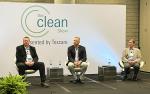
American Laundry News met with the heads of three key laundry industry associations to discuss concerns, positive movement in the industry, and future goals for associations, their members, and the laundry industry as a whole.
Sarah Brobeck is president and CEO of ALM, the Association for Linen Management in Richmond, Kentucky, which supports professionals working in laundry operations and linen management across healthcare, hospitality, and institutional settings.
Lucy Pettys brings the supplier perspective as executive director of TCATA, the Textile Care Allied Trades Association, based in Indian Trail, North Carolina.
And Joseph Ricci is president and CEO of TRSA in Arlington, Virginia, which promotes the linen, uniform, and facilities services industry.
(You can listen to the complete conversation through our podcast on AmericanLaundryNews.com/podcasts.)
What developments do you see coming in the industry that you’re excited or concerned about?
RICCI: I’m excited about the automation and technology and implementing of AI or artificial intelligence. I think there’s just so much that we can do to improve productivity, improve our customer relations, improve our ability to manage product within the plant, to optimize routes, to really impact every part of our business. We’ll be impacted by something that’s going on in automation and technology and AI right now.
I think harnessing that and using that to improve your operations, to maybe, as Sarah mentioned, reduce or eliminate some of these jobs that have continuous ergonomic issues.
There are just a lot of elements of that coming into play that make me excited about what the future looks like. You saw some of it at the last Clean Show. It was really the first time we saw robotics in play, and we’re seeing that now in plants.
We’re seeing some of the quality control that they’re using and sorting technology that’s using AI and technology and imaging. It’s really the combination and collaboration of these different technologies together that I think will have the most impact.
I think I see our members, and the industry as a whole, starting to pursue their own parts and pieces of that puzzle. I think oftentimes our guys will really rely on our equipment manufacturers or chemical manufacturers or somebody else to come up with some kind of performance metrics or software. I think now they’re kind of taking that on their own, and I think artificial intelligence will help them be able to do that.
I’m excited to see that and how they adopt it and how the best operators put that into play as a competitive advantage.
BROBECK: I agree, Joe, and I think it’s exciting to see that we’re using this to accelerate the industry. It gives us the opportunity to redesign work and remove some of the repetitive and physically demanding tasks, and even to create some more roles for people.
But I think we’re going to have to be very cognizant that our concern is whether we’re developing people as quickly as we’re developing our plants within that technology, and that goes right into that skills gap. We need that more sophisticated level of trained operator, and we are going to have to be mindful of that as we continue to adapt and use this technology to make our plants more efficient.
PETTYS: I think the AI technology is such an opportunity. Some people see it as a risk, but I see it as an opportunity. And it’s an opportunity for us as associations to help our members stay in front of any issues that may be coming down the line or any new technology that’s coming up.
Let’s close out by each sharing what plans your association has to help move the industry forward.
BROBECK: We are actively looking for ways we can help our members stay engaged and learn and connect and grow. And stay engaged 365 days a year, not just when we have in-person events or specific things that are going on. You may hear of some things that are coming out new with ALM in order to help us in those efforts with that.
It goes back to trying to do quick, little learning tidbits, but also making a very concentrated effort to help our members in all areas of operational excellence and the training and the education that goes into that.
I think you’re going to see some different things from us roll out here within the next few months that are going to be really exciting and hopefully really help our operators in all of their efforts to have operational excellence.
PETTYS: That’s awesome. I like that, Sarah. That’s a good way to put it. I feel TCATA’s role is to keep our members informed and connected and keep our fingers on the pulse of all the things, whether it be economic or political, and bring that information back to our members.
To piggyback on what Sarah said, we’ll have some new things coming up as well. They’re still in the development phase with our strategic planning process, but I’m really excited about the new initiatives we have coming out and moving the industry forward.
RICCI: We’re very optimistic about our advocacy efforts in Canada and the United States, at the federal and state levels, on the operating threshold of reusable healthcare PPE [personal protective equipment] and, particularly, on the tax incentives. We’re starting to see some traction there. We’re hopeful to get one through here soon.
We’ve got some positive recognition for tax incentives in Texas. Starting in 2027, we’ve been able to reduce our operators’ taxes in Texas in half — roughly $20,000 to $25,000 a year per plant, so significant. We’re hopefully being able to do some of those same things, so they can, you know, buy more equipment from TCATA (members) and build out their plants.
I think the one thing that I always try to reiterate, and Sarah said this earlier about sustainability, our industry is just naturally, as a business, sustainable. Using less energy, less water, less chemicals; reusing, repairing, repurposing textiles, and recycling some of them. All those things positively impact our bottom line, so the incentives are always to be more sustainable.
I think driving that will be really interesting, and continuing to implement those things from a sustainable practices standpoint will help the industry reduce some of those costs and be more attractive as an employer and a provider.
I think those are really critical issues that the industry needs to continue to leverage to its advantage.
Click HERE to read part 1 about what association leaders see as the most pressing issues they see in laundry industry.
And HERE to read about further industry issues plus positive developments from the association heads.

Have a question or comment? E-mail our editor Matt Poe at [email protected].