CHICAGO — Recent advancements in laundry technology offer operators a range of solutions, but it’s essential to identify those solutions/answers that deliver the fastest return on investment (ROI).
Clean 2025 in Orlando showcased innovative technologies, prompting consideration of factors such as financial impact, spatial requirements, capacity, revenue, expenses, ROI, and profitability.
In other words, “What’s going to give me the biggest bang for my buck?”
Modern technology enables improved performance tracking, productivity optimization and labor-cost control. We have data to improve profitability, to improve our bottom line.
Over the past decade, the laundry industry has experienced significant technological progress. To begin adopting new solutions, operators should assess plant pain points, such as labor, energy consumption, and downtime.
What’s your largest expense? What’s the benchmark in our industry for this expense? How does your laundry relate to that benchmark? What can we do to improve this measure?
Start with incremental, or small, changes. Defining clear goals and ROI is critical.
ROBOTICS AND AI
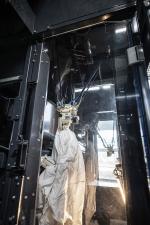
The biggest and newest laundry automation concepts are robotics and artificial intelligence, or AI. While full automation (“dark laundry”) remains aspirational, its practicality and cost-effectiveness require careful evaluation.
There are questions that need to be answered before entertaining the thought of purchasing advanced robotic machines, including:
- What’s the cost for robotics?
- Will this cost save me the labor expense needed for my ROI?
- Will these robotics work out as advertised?
- How long will they last?
- How much space do they take up?
- Who will repair them?
- What’s the maintenance on these machines?
The transition to fully automated laundry operations will likely begin in the soil-sorting department with robotics. In the United States, there are already laundries using robotics in their soil departments. When asked about the ROI on this equipment, these laundry executives state that they’re looking for the future and what might extend from these initial tests of robotics.
In other words, they’re not sure how long the ROI is.
Automated feeding for ironers and folders, and pack-out systems, is expected to become more available within the next five to 10 years. Unless you have money to gamble with, robotics may not be what you want to start with in 2026.
AI is also a “hot button” and can enhance logistics, scheduling, predictive maintenance, energy optimization, quality control and route forecasting. This is exciting.
However, successful implementation depends on readiness, investment, and the availability of beta test sites. AI must review the operation repeatedly to understand what data is helpful.
Remember, we expect AI to help us with critical decisions. It will take AI some time before it becomes effective in improving laundry procedures.
So, what can we do today? Manual and normal technical processes can still yield profitability, but leveraging today’s technology — and preparing for tomorrow’s advancements in AI and robotics — will drive further improvements.
Three immediate technology improvements are radio-frequency identification (RFID), connected equipment, and intelligent software.
RFID
RFID technology is increasingly used for inventory management and forecasting of production operations.
Some laundries are putting RF chips into almost all of their products (linen, garments and mats). Vendors are putting chips in their products, and the ability to read these chips is becoming standardized. Laundries are already reading RF chips in the soil and pack-out departments.
Every software system promotes the use of RFID information. The cost of these systems is a fraction of what it once was. Everyone involved with RF chip technology provides information on a reliable ROI on this investment.
Textile costs are still one of the major expense types in our laundry industry. One hospital laundry informed me that it is at a 100% annual purchase cycle on its inventory. This means if it has $4 million in inventory of linen, then it spends $4 million to replenish this linen every year.
This is probably an extreme case, but what’s your textile expense? More importantly, why is your textile expense at the rate or level it is? RF chip programs can help provide data to answer these questions.
Check back Thursday for the conclusion about connected equipment, intelligent software and the importance of data.

Have a question or comment? E-mail our editor Matt Poe at [email protected].