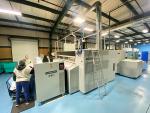
CHICAGO — For years, robotics in commercial laundry operations felt “just out of reach” because of high hardware costs and limitations in dexterity.
However, recent exhibits at Texcare International and The Clean Show have placed robotics at the fingertips of industrial and institutional laundries.
“What’s changed is the democratization of robotics — hardware costs have dropped significantly, software and vision systems have matured, and AI (artificial intelligence) now has opened the door to solving the nuance of linen handling at scale,” says Nick Dobrez, director of marketing for Spindle, a laundry data and technology platform.
“At the same time, the labor shortage crisis has become the industry’s largest threat, making automation no longer a nice-to-have but a survival strategy.”
Engineering efforts have shifted toward building more advanced, reliable robots that can better understand linen and mimic human tasks like sorting and identification, says Casey Lott, marketing director for equipment manufacturer Kannegiesser North America.
“By learning from other industries, laundry robotics are now more durable and better equipped for real-world conditions,” he says.
“You can actually pinpoint the jobs that can be classified within the four Ds of robotization: dirty, dangerous, dull and difficult,” says Umair Qureshi, software director at Inwatec, which provides robotic and automation solutions for industrial laundries. “And this is exactly where the focus for robotics and automation comes in.”
These intersecting trends mean more robotics solutions are being introduced into laundry operations, bridging gaps in efficiency and sustainability.
COMMERCIAL LAUNDRY’S GOLDEN AGE?
The pace of change is accelerating.
“We believe we’re entering the Golden Age of commercial laundry,” says Dobrez. “I believe we’ll move from task-level automation (robots feeding one ironer) to system-level orchestration — a unified platform where robotics, AI and vision coordinate the entire plant.
“In 10 years, laundries might be able to operate with hyper-efficiency, where linens move seamlessly from soil dock to clean delivery with minimal human intervention on the operations side.
“The industry will become a showcase for advanced industrial automation and applied AI, while employees take on higher-value roles in supervision, QA (quality assurance), and data-driven decision-making.”
Lott agrees that in the next decade, robotics will be more integrated into laundry operations, but they’ll be just one part of a much broader evolution.
“The real progress will come from how automation, intelligent software, and skilled teams work together to create smarter, more efficient workflows,” he says.
“I see the future not just in faster machines, but in connected systems, better-trained staff, and environments that support long-term retention and growth. It’s about building operations that are more resilient, more attractive to the next generation of workers, and better equipped to meet the demands of a changing market.”
There is widespread fear, points out Mads Andresen, founder of Inwatec and chief innovation officer at the JENSEN-GROUP, that by implementing robotics, laundries will need more maintenance and much higher-paid skilled staff to handle the machines.
However, maintenance for robotics is comparable to standard machinery, and tech-savvy generations adapt quickly. Gradual rollout and training help ensure smooth adoption.
“Maintenance and service is not more complicated on robotics than on today’s standard industrial laundry machines,” Qureshi says. “Laundries that take the step to robotics get more satisfied employees, (and) better quality of work.”
Read Part 1 — about how laundry robotics challenges have been overcome — by clicking HERE.
Click HERE to read Part 2 about what issues robotics is solving for laundries today.
Have a question or comment? E-mail our editor Matt Poe at [email protected].