CHICAGO — For years, robotics in commercial laundry operations felt “just out of reach” because of high hardware costs and limitations in dexterity.
However, recent exhibits at Texcare International and The Clean Show have placed robotics at the fingertips of industrial and institutional laundries.
“What’s changed is the democratization of robotics — hardware costs have dropped significantly, software and vision systems have matured, and AI (artificial intelligence) now has opened the door to solving the nuance of linen handling at scale,” says Nick Dobrez, director of marketing for Spindle, a laundry data and technology platform.
“At the same time, the labor shortage crisis has become the industry’s largest threat, making automation no longer a nice-to-have but a survival strategy.”
Engineering efforts have shifted toward building more advanced, reliable robots that can better understand linen and mimic human tasks like sorting and identification, says Casey Lott, marketing director for equipment manufacturer Kannegiesser North America.
“By learning from other industries, laundry robotics are now more durable and better equipped for real-world conditions,” he says.
“You can actually pinpoint the jobs that can be classified within the four Ds of robotization: dirty, dangerous, dull and difficult,” says Umair Qureshi, software director at Inwatec, which provides robotic and automation solutions for industrial laundries. “And this is exactly where the focus for robotics and automation comes in.”
These intersecting trends mean more robotics solutions are being introduced into laundry operations, bridging gaps in efficiency and sustainability.
ISSUES ROBOTICS IS SOLVING TODAY
Robotics is helping laundries overcome bottlenecks in repetitive tasks, shares Lott: “By reducing manual strain and enabling continuous operation, they support higher throughput and more consistent results.”
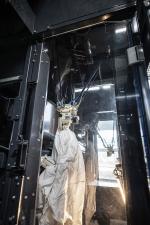
Think soil-side sorting and feeding processes on the clean side. This is precisely where dull, dirty and dangerous work happens. Robotics now speeds up sorting, boosts accuracy, and protects staff from hazards like sharp items concealed in pockets.
“Our automatic soil-side sorting is definitely replacing the dirty and the dangerous jobs,” points out Mads Andresen, founder of Inwatec and chief innovation officer at the JENSEN-GROUP. “We are already counting more than 170 global references in that field.
“These are the jobs where robotics can have the highest impact.”
“This shift allows facilities to scale without relying solely on shift-based labor,” Lott adds, “easing staffing pressure and improving reliability. Whether the goal is to reduce labor costs or optimize production, robotics is delivering flexibility where it’s needed most.”
Concerns about robotics replacing jobs are natural, but the reality in laundries is different. Robotics mainly takes over those tasks that are not the most popular ones to handle anyway, while making work safer and more appealing, and also helping fill gaps where labor is short. Staff routinely transition to higher-impact roles or shift to open positions within the same organization.
“My grandmother was worried 25 years ago about robots taking jobs,” Andresen shares. “But the right question is, how do we actually get enough people to do the repetitive work needed in industrial laundries?”
“I completely understand the concern, but the reality is that laundries, like manufacturing more broadly, are struggling to find enough workers,” agrees Dobrez. “A recent (Manufacturing.net) article pointed out that even in the middle of a U.S. manufacturing boom, plants can’t fill all the jobs they need to run efficiently. The same is true in our industry. Operators tell us every day that they simply can’t staff enough people for the most repetitive and strenuous roles.
“That’s where robotics comes in. This isn’t about replacing people; it’s about filling roles that are already going unfilled, and about reducing the dangerous, physically taxing jobs that burn people out quickly.
“In fact, automation helps protect the jobs that remain, because it keeps laundries competitive and ensures the work environment is safer and more sustainable for the long term.”
“Think about how your current production relies on shift-based staffing to manage volume, breaks and scheduling,” Lott says. “Now imagine, for example, simply automating your terry small-piece towel finishing. This one change could allow four to six high-volume items to be processed consistently, without needing to plan around labor availability.
“It frees up your team to focus on larger pieces and more complex tasks, while robotics quietly handles a major portion of your daily output. It’s a simple shift that opens up new flexibility in how you run your operation.”
Increasingly, robotics represents upskilling and opportunity in the face of the labor market reality.
“Robotics isn’t about cutting jobs; it’s about creating a better work environment that helps you attract and keep the right people,” shares Lott. “By automating repetitive tasks, your team can move into roles like quality control, logistics, or maintenance. That shift appeals to younger, tech-savvy workers who want to grow with your business.
“If someone can say they work with automation and robotics instead of just saying they work at a laundry, they’re more likely to stay. One smart hire managing automated systems can replace several manual roles and help you stay competitive.”
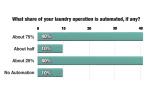
Robotics is set to bring near-total automation to laundries over the next decade, especially in feeding, sorting, and logistics. Most manual tasks will be automated, enabling safer, more efficient, and higher-quality workflows.
“Already in the next five years, there will be a huge development in the feeding area,” Andresen says.
Extended sorting and logistics innovations are expected to follow. While lights-out (fully automated) factories may not be practical everywhere, operators will increasingly be able to manage facilities remotely with minimal intervention.
“You will be able to operate your factory reliably without compromising throughput by being remote,” says Qureshi.
Read part 1 about how laundry robotics challenges have been overcome by clicking HERE.
Come back Tuesday for the conclusion about the possibility of entering a “golden age” of laundry robotics.
Have a question or comment? E-mail our editor Matt Poe at [email protected].