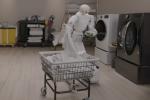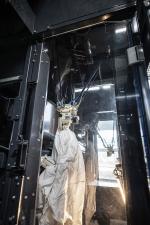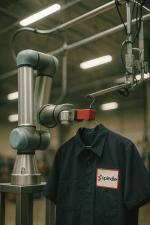
CHICAGO — For years, robotics in commercial laundry operations felt “just out of reach” because of high hardware costs and limitations in dexterity.
However, recent exhibits at Texcare International and The Clean Show have placed robotics at the fingertips of industrial and institutional laundries.
“What’s changed is the democratization of robotics — hardware costs have dropped significantly, software and vision systems have matured, and AI (artificial intelligence) now has opened the door to solving the nuance of linen handling at scale,” says Nick Dobrez, director of marketing for Spindle, a laundry data and technology platform.
“At the same time, the labor shortage crisis has become the industry’s largest threat, making automation no longer a nice-to-have but a survival strategy.”
Engineering efforts have shifted toward building more advanced, reliable robots that can better understand linen and mimic human tasks like sorting and identification, says Casey Lott, marketing director for equipment manufacturer Kannegiesser North America.
“By learning from other industries, laundry robotics are now more durable and better equipped for real-world conditions,” he says.
“You can actually pinpoint the jobs that can be classified within the four Ds of robotization: dirty, dangerous, dull and difficult,” says Umair Qureshi, software director at Inwatec, which provides robotic and automation solutions for industrial laundries. “And this is exactly where the focus for robotics and automation comes in.”
These intersecting trends mean more robotics solutions are being introduced into laundry operations, bridging gaps in efficiency and sustainability.
OVERCOMING CHALLENGES
Over the last half-century, laundry automation has evolved gradually, from mechanical solutions and conveyor belts to PLC (programmable logic controller) controls in the ’80s and ’90s, followed by sophisticated robotics and vision systems in the past 15 years.
Dobrez shares that early automation in laundries focused on mechanical systems like rail, conveyors, and sorters, which focused on moving goods but lacked adaptability. When robotics were first introduced, trials showed promise, but early robots were hampered by high cost, slower speeds, and the inability to “see” and reliably manipulate textiles.
“Textile and laundry is so difficult to automate because it’s never the same, dealing with infinite dimensions of objects,” Qureshi points out.
To work around these challenges, Dobrez says the industry shifted toward building larger, specialized machines with integrated robotic functions that could perform a single task within an enclosed system but required a large footprint to do so.
Mads Andresen, founder of Inwatec and chief innovation officer at the JENSEN-GROUP, adds that, “Now the current robotics on the soil side has been a major invention. AI can do more adaptive and intelligent jobs, which brought us sorting solutions.”
These innovations are driving progress despite ongoing complexity.
“Advancements in gripping technologies, computer vision and AI-driven vision models have significantly improved a robot’s ability to handle the variability of fabric,” Dobrez shares. “As hardware has advanced, so too have the software tools available to developers, enabling teams to extract more value from their solutions.
“It’s only a matter of time before our industry starts seeing some of these benefits.”
Lott points out that by studying human workflows, engineers have taught robots to identify and separate items more effectively. AI-driven software now helps systems learn from mistakes, making automation practical where it wasn’t just a few years ago.
“Robotics and automation are really a culmination of all the different fields and domains that come together,” Qureshi says. “Intelligent software advancements, real-time processing and manipulation skills all combine.”
Andresen directly states, “It has not been overcome, yet. It’s an evolution.”
Integration is key, and continual development is pushing boundaries in both speed and agility.
Today’s laundry robots use a hybrid learning approach. While operational programming is still being used for basic, high-volume tasks with low variability (like stacking), AI and machine vision are essential for modern deployments. While collaborative robots have begun to include more advanced controls, real autonomy and adaptability are still being developed for use in the laundry industry.
“Robots are becoming more adaptive by learning from repeated patterns in how linen is presented and processed,” Lott shares. “AI helps systems refine their movements and decisions over time, improving accuracy in tasks like feeding, folding and stacking. While programming still sets the foundation, it’s the ability to learn from real production that’s driving more consistent and intelligent performance.”
“The robots do not learn and adapt on their own. That’s rarely the case today,” Qureshi says.
He expects adaptive robotics powered by AI to become mainstream, potentially within five years, but notes, “AI will deliver adaptive robotic solutions.”
Check back Thursday for part 2 about what issues robotics is solving for laundries today.

Have a question or comment? E-mail our editor Matt Poe at [email protected].