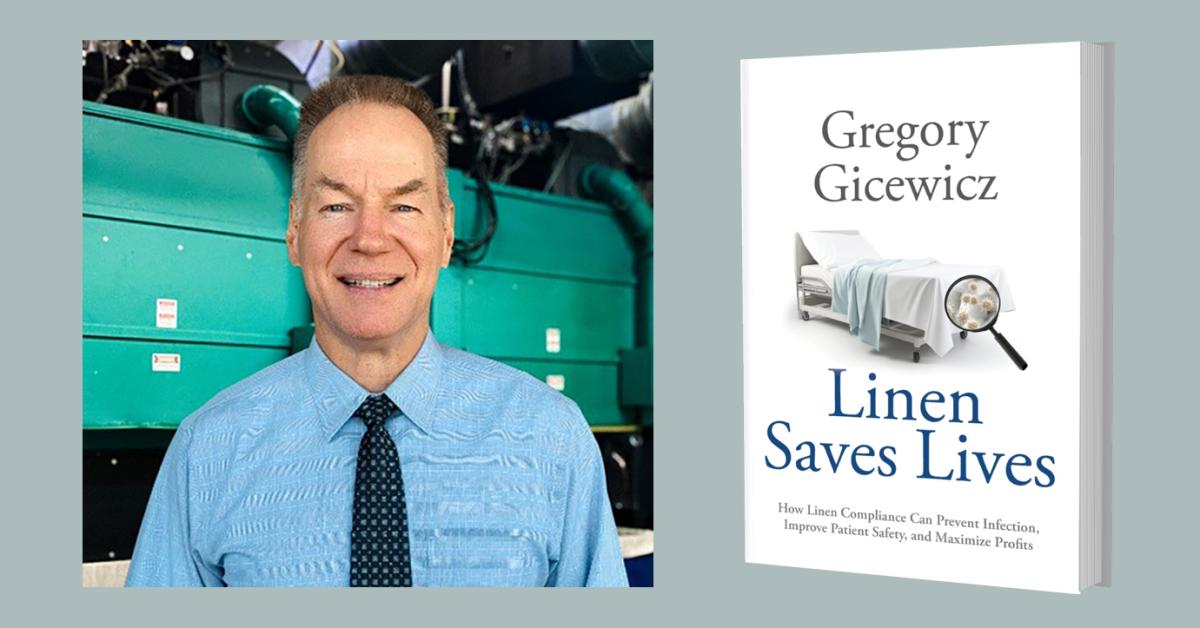
CHICAGO — Gregory Gicewicz is a man on a mission.
He’s a veteran healthcare laundry operator, currently COO of Fillmore Linen Service in Chicago, and a compliance expert who founded Compliance Shark, a healthcare linen consulting firm.
His mission? To expose how linen quality, handling, and process control directly impact infection prevention, patient outcomes, and operational profitability.
Gicewicz’s most recent effort in this pursuit was writing a book, “Linen Saves Lives” (available on Amazon), a guide for professionals in the commercial and healthcare laundry industry.
American Laundry News recently spoke with Gicewicz about his book and his mission.
How did this book come about?
After owning and operating our own accredited healthcare laundry (Sterile Surgical Systems), about five years into it—after seeing some of the crazy things that happen routinely—I remember thinking to myself, ‘I really need to write a book about this!’
What started as a half-joking comment eventually turned into a serious conviction. I had seen firsthand how something as simple as clean linen could make or break a hospital’s infection prevention efforts and how often it was overlooked, misunderstood, or mishandled by both laundry operators and clinical staff.
Over time, I began consulting with hospitals and realized the same problems—and the same blind spots—kept surfacing. I wrote this book to share what I’ve learned, to tell the real stories, and to provide a practical, clear-eyed guide for both sides of the industry.
My hope is to help elevate linen from an afterthought to what it truly is: a frontline tool in patient safety.
Share a little about how your industry experience, and any research, influenced your writing.
Over the years, I’ve had the opportunity to work closely with many researchers in areas critical to healthcare linen safety—how pathogens survive and move through the linen life cycle, how antimicrobial technologies function, how to test effectively for contamination at different stages, and how various linen processing methods impact cleanliness and risk.
Those collaborations, combined with my direct operational experience running accredited healthcare laundries, gave me a unique vantage point. I’ve seen what happens on the ground, in the plant, and in the hospital, and I’ve also learned what the science tells us.
This book brings those two worlds together—real-world lessons and evidence-based practices—into one practical, readable guide for both laundry and healthcare professionals.
Who in the laundry industry should read it and why?
Anyone responsible for healthcare linen—from operators to supervisors to executives—should read this book. It’s especially valuable for teams working with hospitals or surgical centers, where the margin for error is razor-thin.
If you handle healthcare linen but aren’t part of clinical care, this book shows you how deeply your work impacts patient safety. If you’re a laundry leader, it will help you build stronger partnerships with healthcare clients, improve compliance and position your services as essential—not interchangeable.
There are all kinds of lessons for the plant operator around areas like performance, sustainability, accreditation/certification, emerging technologies and building a laundry.
What are some key ideas laundry operators will gain from the book?
Laundry operators will walk away with a stronger understanding of the following:
- How infection risks can originate—or be stopped—at every stage of the linen cycle.
- The true meaning of compliance, beyond Healthcare Laundry Accreditation Council (HLAC) or TRSA checkboxes.
- How to communicate better with hospital partners—using their language and priorities.
- Ways to improve quality, safety and profitability without cutting corners.
The book also offers clear frameworks for staff training, linen handling and auditing—all designed to boost performance and trust with healthcare clients.
What are some key insights healthcare operations will learn?
Healthcare teams will learn that linen isn’t just about comfort or cost—it’s a frontline infection-prevention tool. The book highlights:
- Common linen-handling gaps inside hospitals that undermine cleanliness.
- How to align EVS (environmental services), nursing and supply-chain practices for better outcomes.
- What to ask of your laundry provider to ensure linen safety and accountability.
- How a well-run linen program can reduce hospital-acquired infections (HAI), improve patient experience and cut waste.
Ultimately, the book shows that linen is not peripheral—it’s clinical. When handled correctly, it protects patients and helps a hospital’s brand. When mishandled, it becomes a risk.
My hope is that this message will reshape how healthcare leaders view linen—not as background noise, but as a vital, strategic asset.
Have a question or comment? E-mail our editor Matt Poe at [email protected].