CHICAGO — Efficient and effective. Those are key goals for every industrial and institutional laundry.
Operators continually seek the best, most efficient methods to process goods in their facilities. That includes the transportation of linens on-site.
Laundry carts, rails and conveyors are crucial to efficiently and effectively moving goods. While it may seem like these technologies are set and limited when it comes to advances, that isn’t the case.
Through communications with operators and investigating how new technologies can be used, on-site laundry transport tech providers are making upgrades and advances.
LAUNDRY CART ADVANCES
Jo Beth Reilly, director of sales and marketing for TECNI-QUIP Carts & Covers in Seguin, Texas, shares that as labor costs rise and availability decreases, her laundry operations customers are seeking efficient solutions to maximize productivity with fewer personnel for cart-based linen transport.
“We are noticing an increased demand for battery or vehicle-towing options for multiple carts or fully battery-powered assist systems placed on individual carts,” she says.
Many TECNI-QUIP linen carts are now equipped with a battery-operated power system that propels the carts, Reilly says.
“This feature is particularly useful when a large, fully stocked cart is pushed long distances or when this cart is constantly touring inside a hospital or hotel 12 hours or more a day restocking linen closets or other carts,” she says.
Key benefits of the battery-operated power system include:
- Fully powered operation for cart operator
- Multiple speed settings for ease of use
- Long-range battery life
- Convenient recharging via standard electric socket
Reilly’s clients frequently request carts equipped with a towing hitch or small towing apparatus attached to the base.
“For indoor applications, cart tugs facilitate the transportation of multiple carts throughout laundry facilities or buildings,” says Reilly. “In outdoor scenarios, such as between satellite buildings or covering long distances from the laundry to the main building, we are asked to install full base towing hitches for the transport of multiple carts by a low-speed vehicle.”
The company has also fielded requests for custom-designed, enclosed, weatherproof cabinets to be mounted on the backs of mules or golf-cart-type vehicles.
“This solution is particularly useful in settings like hotels, campgrounds, or national parks, where clean linen is transported from the laundry center to cabins, villas, or casitas,” she points out. “These cabinets are designed to carry clean linen and supplies on one side while efficiently managing soiled linen and trash on the other side.”
Many of these enhancements come from dealer-client interactions and requests.
“When our dealers encounter unique situations that require more than a standard solution, they introduce [our company], our capabilities, uniqueness as a cart manufacturer, and our custom capabilities,” Reilly says. “With the help of our dealer, we communicate with the customer and figure out ways to address their specific requirements.”
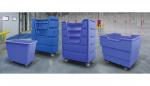
She says the company has experienced an increase in sales of its L-Mini-Series and C-Cell Models, which consist of smaller, enclosed carts featuring a front cover or doors.
The Mini Models are enclosed push-type carts used to assist linen teams in delivering smaller quantities of linen from larger carts or closets to labs, patients, clinics and more.
“This solution enhances efficiency while minimizing human exposure to the linen and ensuring compliance with healthcare Joint Commission codes for healthcare delivery in a covered cart with a solid base,” says Reilly.
C-Cell Models are tall, narrow carts designed to fit almost anywhere, she says. This model utilizes a smaller footprint while maximizing capacity for its height.
“We offer several sizes and custom options to meet diverse needs,” shares Reilly. “These carts have gained popularity in acute healthcare settings, where space is often limited, as well as in clinics and outpatient surgery centers.”
Dan Rodriguez is director of sales and marketing for Tank Holding Corp., a manufacturer of rotationally molded poly and welded-steel bulk-storage and material-handling products headquartered in Lincoln, Nebraska, whose laundry cart brands include Meese.
His company has seen a significant increase in laundry operator requests for ergonomic enhancements, he notes, particularly regarding spring platforms and cart configurations for ironer feeding.
To maintain a continuous flow of product for ironers, Tank’s brands have optimized cart widths to 59 or 60 inches, ensuring four team members can rotate carts efficiently to meet the 120-inch feedboard standard.
“(With these enhancements) there’s a constant flow of product coming into the ironer,” Rodriguez says. “It’s not a new innovation, but it’s one that’s getting more attention than it ever has before.”
When operators report that spring platforms are not lifting the product to the operators fast enough, the team investigates and adjusts the weight capacity to better serve the user.
Beyond spring platforms, casters are critical to cart products to improve ergonomics and operational efficiency, Rodriguez says. The company has prioritized innovations in plastic and rubber for casters and high-density polyethylene resin, which it upgraded seven years ago.
“We’re constantly looking at what’s the next plastic innovation to make them lighter but heavier duty, and it’s really hard in our industry because our customer base (thinks) heavier means heavy duty,” he points out. “No, it doesn’t. Think of the difference between steel and carbon fiber. Carbon fiber is five times stronger than steel but it’s five times lighter as well, but people don’t see it that way. It’s hard to get the mindset changed.”
Rodriguez says investments in advanced material technology can aid in delivery truck fuel economy and that investments in ergonomic features like spring platforms can drastically reduce the cost of workers’ compensation claims.
He goes on to share that several technological advancements have come about because carts have evolved from general-purpose containers to specialized units designed to interface with automation, rail systems, and autonomous bases.
“Robotics companies are developing their own proprietary bases made out of stainless steel, and then they’re sending them to us and asking us to put the bodies on top of these bases and then sending them out to healthcare facilities,” he says.
What is an autonomous base?
“When these facilities are built, or even post-construction, (operators) put these tracks in that go along the walkways,” shares Rodriguez. “Say (the cart route) is from the laundry out to the hospital floor or the shipping area to another area in the hospital. These autonomous bases read those lines that are built into the floor and travel with the carts to make those deliveries.
“It’s all battery-operated. They have a notification on the system that if one is getting low on battery, it ‘runs’ back to the base and charges itself, and then it’ll put itself back into operation.”
Rodriguez says the autonomous bases are increasingly using advanced sensing technologies.
“With AI (artificial intelligence), they’re getting smarter, and they’re thinking that, with LiDAR (light- or laser-imaging detection and ranging) and all these other technologies that you see in a lot of cars like Teslas, they’re going to be able to apply that to these autonomous spaces and not have to have the built-in tracks in these facilities. They can just be able to sense the walls and navigate to where they’re supposed to go.”
Continuing with future cart technology, he identifies radio-frequency identification (RFID) as a key area of interest for tracking both linen and the carts themselves to reduce losses, citing examples of carts being used for improper purposes in hotels. The company is exploring how to incorporate next-generation chips into the molding process, despite the challenges posed by the high temperatures used during manufacturing.
Since the coronavirus pandemic several years ago, Rodriguez says the company has implemented the use of advanced silver materials in its cart-molding process to provide an antimicrobial solution. While acknowledging that the cost can be prohibitive for some, he notes that for healthcare organizations focused on cleanliness, the investment is viewed as a necessary tandem component alongside cart washers.
Finally, Rodriguez says that the company has looked at cart technology and usage internationally and observed the European market’s preference for metal carts, which account for roughly 80% of usage in Europe, compared to the opposite ratio in the United States (80% poly).
“We’re offering the European-style carts that have taken off and bringing them to the States,” he says. “We just started rolling that out within the last six months.”
Check back Tuesday for the conclusion about rail and conveyor upgrades.
Have a question or comment? E-mail our editor Matt Poe at [email protected].