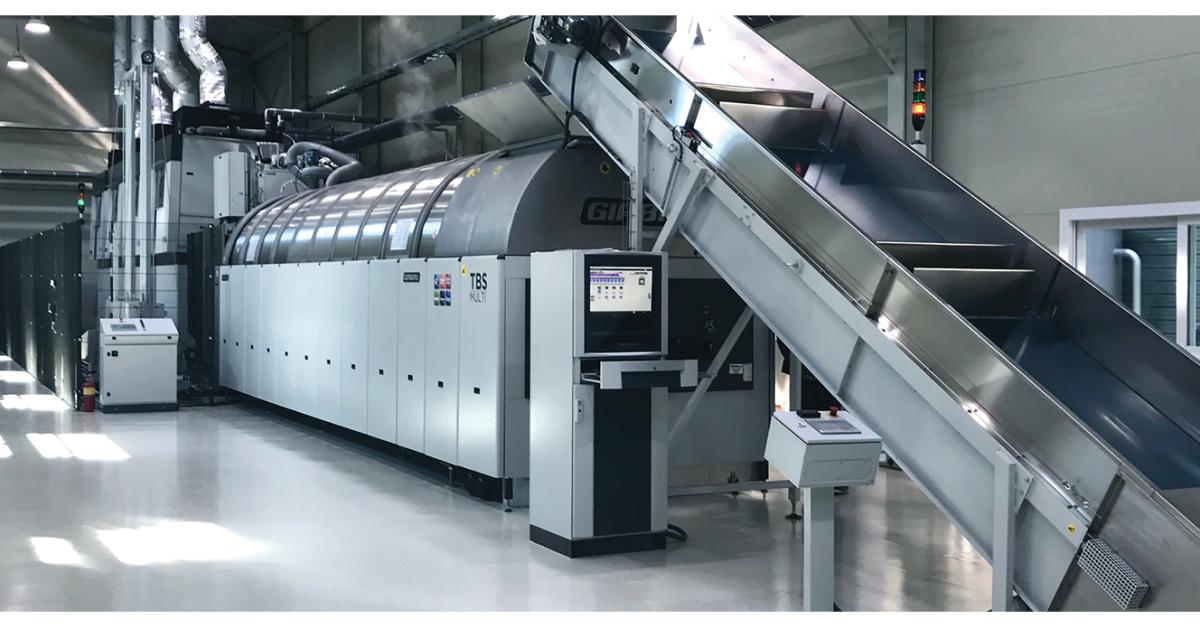
CHICAGO — Tunnel washers have come a long way in the past decade, says Brennan Pollnow, Girbau Industrial’s national sales manager.
“The biggest shift is that they simply have smarter user interface and reporting; it’s cleaner and more efficient,” he says. “Everything from water flow to chemistry to mechanical action is more intentional now, and operators feel that difference every day.”
Tunnel systems were originally designed around batch sizes of 35 to 110 pounds, recalls Jim Shaw, vice president and national accounts sales manager for LAVATEC Laundry Technology Inc.
“In recent years, the batch capacities have doubled and increased to more than 250 pounds,” he says. “This modification has resulted in doubling production capabilities.”
“We have seen a clear shift in how tunnel washer performance is defined,” says Ed Kirejczyk, president of Sea-lion America Company. “The industry is no longer asking whether tunnel systems are efficient — they are. The question now is how to extract the next level of productivity from systems that are, in many respects, already highly optimized.
“Our recent engineering efforts have focused on this exact challenge. The result is not a single breakthrough, but a series of targeted enhancements across pressing, drying, controls, and maintenance systems. When combined with disciplined operational practices, these improvements deliver measurable gains in throughput, energy efficiency, and system reliability.
“Importantly, our approach has been grounded in a practical philosophy: efficiency must be achievable in real operating environments — not just under ideal conditions.”
Casey Lott, marketing director for Kannegiesser North America, says that tunnel washers today are built for better hygiene, greater flexibility, and far lower consumption than what was seen five to 10 years ago.
“Modern systems handle a wider textile mix while using a fraction of the water, energy, and chemistry older designs needed,” he says. “Batch-specific processing, tighter thermal control, and cleaner internal flow make today’s washers faster, smarter, and a lot more efficient.
“The direction is simple: the future is all about doing more with less, delivering strong wash results with greener, lower-impact operation that fits the new age of commercial laundry.”
UPGRADES IN DESIGN, MECHANICAL ACTION
“Automation has come a long way, and improvements that are being developed make tunnels better every time,” says Antonio Casillas, general manager of Southern Oregon Linen Services in White City, Ore.
“Compared to (LAVATEC’s) older tunnel we had for years, the difference is night and day with the new software and features. When issues come up, the new tunnel cuts our downtime to 20 to 40 minutes to clear it, and no one has to be crawling inside. The software pinpoints the issues, so our engineers are able to address them in minutes, creating little to no downtime.”
Shaw says that unlike standard manufacturing processes, where every machine is constructed the same, each tunnel is specifically designed for the application. The rib size, location and cylinder rotation directly affect the wash action.
“JENSEN has an option called QuickSoak that is integrated into the beaters/ribs in the first compartment of a tunnel washer,” points out Patrick Gittard, marketing manager at JENSEN USA. “It scoops up water when submerged and then dumps it over the linen as it turns. This adds mechanical action as water passes through the linen, while also aiding in the soaking and dispersion of chemicals throughout the batch.”
“Modern tunnels don’t rely on brute force anymore,” Pollnow states. “The action inside the modules is more controlled and targeted, so you get better soil removal without beating up the linen. It’s a cleaner wash with less wear — a win on both sides.”
Brock Pellerin, vice president of Pellerin Milnor Corp., says a major improvement to tunnel washing in recent years has been the ability to effectively remove lint and suspended solids directly from the wash liquor.
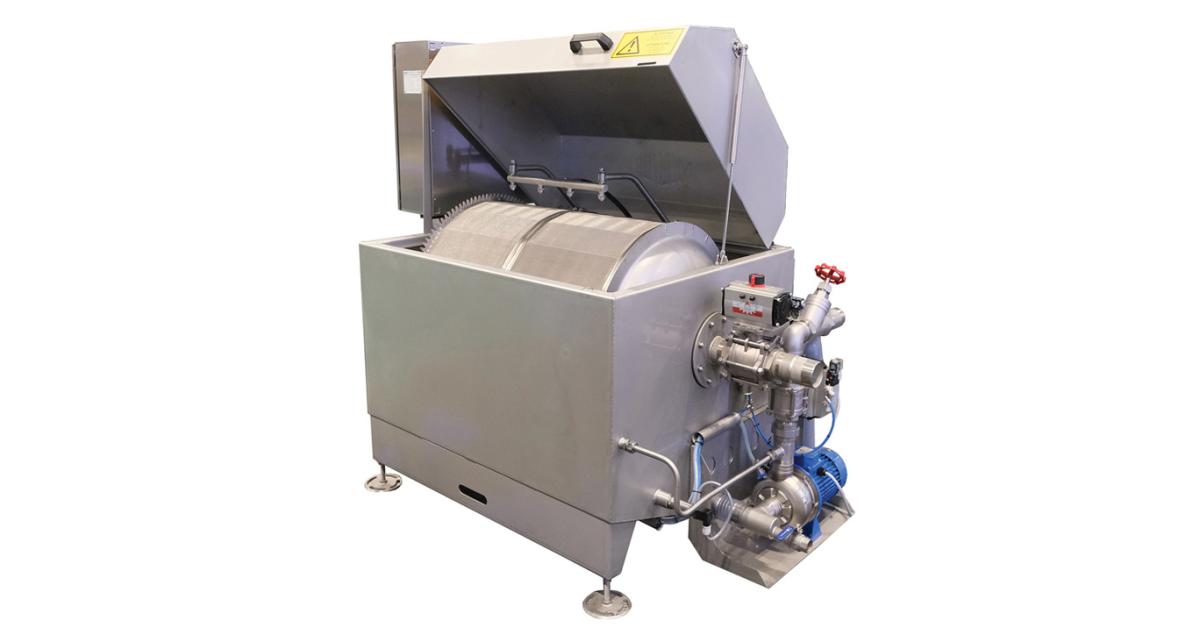
“Lint accumulation has long posed challenges, particularly in tunnels that process food and beverage and in high-volume laundries, both in the wash system and downstream wastewater treatment,” he says. “To address this, we now offer a rotating drum filter that continuously and efficiently separates liquid from solids during operation.”
In this system, wash liquor is fed into a centrally located inlet and passes through a rotating filter drum, he shares. The liquid flows through the filter mesh and is returned to the wash process, while lint and other particles larger than the mesh size are captured on the surface, forming a filter cake.
As the drum rotates, this material is gradually lifted, dewatered, and conveyed upward. At the top of the drum, the accumulated solids are removed using compressed air or a water jet and then discharged via a spiral conveyor. This allows for continuous, automated removal without interrupting operation.
“A rotating drum filter significantly prevents lint from redepositing onto textiles and enhances system efficiency by keeping wash liquor cleaner,” adds Pellerin. “It also eliminates the need for a shaker screen.”
In tunnel washing systems, the extraction press is often the true capacity constraint, Kirejczyk points out. Recognizing this, Sea-lion America has introduced a rapid-descent function in the basket press, reducing the pressing cycle by approximately 15 seconds per load.
From an engineering standpoint, this is a straightforward mechanical improvement, he says. From an operational standpoint, it is highly impactful.
“In real-world installations, we consistently see that improving extraction-press efficiency yields a more immediate throughput gain than increasing tunnel drum speed,” Kirejczyk says. “This reinforces a principle we emphasize to operators: performance of a tunnel system is defined by its slowest component — and in many plants, that component is extraction.
“While many designs focus heavily on wash module optimization, our experience is that balanced system engineering — especially in extraction — delivers more reliable gains in actual plant conditions.”
IMPROVED WATER, ENERGY USAGE
Water and utility are the tunnel washer areas where there are the biggest gains, according to Pollnow.
“Newer tunnels are designed around smarter dilution and recirculation, so they use dramatically less water and heat than older systems,” he says. “That translates directly into lower operating costs and a much faster return on investment.”
“Water use is way down thanks to smarter reuse loops and filtration systems that keep liquor cleaner and stretch every gallon further,” Lott adds.
By design, most tunnels reuse water from the point of introduction of fresh water in the rinsing zone, to discharging contaminated water at the flush and early in the wash zone, explains Shaw.
“The tunnels wash in reuse water and should rinse in clean, fresh water. The utility savings are a result of the counterflow process during the wash and rinsing process,” he says. “Systems can also be added to recover heat from the water being discharged to the sewer. We use high-efficiency motors, soft start and VFD (variable frequency drive) components to reduce electrical consumption as well.”
Drying remains the most energy-intensive phase of the laundry process, and also one of the most common bottlenecks, according to Kirejczyk.
“Our approach has been to address both airflow dynamics and thermal efficiency,” he says. “To address this, we have redesigned the combustion chamber structure in our gas dryers to incorporate a high-efficiency hot-air nozzle system, improving heat distribution and transfer efficiency.
“In parallel, we have implemented PID-based (proportional, integral, derivative) temperature control algorithms. This allows the system to maintain precise thermal conditions without overshoot, which is a common source of wasted energy in conventional systems.
“In practice, we find that consistency of drying performance is just as important as peak efficiency, particularly in plants processing mixed classifications. Systems that rely on narrow operating windows may perform well under ideal conditions but can lose efficiency quickly when variability is introduced.”
Check back Tuesday for part 2 about upgrades in tunnel washer chemistry, controls, maintenance and footprint.
Have a question or comment? E-mail our editor Matt Poe at [email protected].