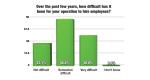
ALEXANDRIA, Va. — Filling open employment opportunities remains challenging for businesses overall, as well as for industrial and institutional laundries.
Operators have been struggling to onboard key personnel such as plant employees, engineers and management even before the events of the past several years.
According to the Society for Human Resource Management’s (SHRM) 2025 Talent Trends report, recruitment challenges persist, with 69% of employers continuing to face difficulties filling full-time roles.
While attempting to fill these roles, 51% of organizations report a low number of applicants, while 41% say they are seeing candidates “ghosting” the organization during the interview process. Meanwhile, the research found programs such as apprenticeships, internships and job rotations are effectively bridging skill gaps, with job rotations boasting a 92% success rate in alleviating talent shortages.
“Our latest research provides a critical lens into the dynamics shaping the future of work,” says Alex Alonso, Ph.D., SHRM-SCP, chief data and analytics officer at SHRM.
“From the increasing integration of AI (artificial intelligence) in HR (human resource) functions to the persistent challenges posed by skill gaps, the findings underscore the need for businesses to prioritize upskilling and adaptability. By aligning workforce strategies with emerging trends, organizations can position themselves to thrive in a rapidly evolving global talent landscape.”
GROWING NEED FOR NEW SKILLS
According to SHRM, 28% of organizations report job roles now require entirely new skill sets, with 47% updating existing roles.
The top three in-demand technology-related skills are data analysis (36%), AI (31%) and cybersecurity (21%).
ROLE OF AI IN HR IS EXPANDING
When it comes to AI, the report says that 43% of organizations now integrate AI into HR functions, with 51% utilizing it for recruitment tasks such as résumé screening and candidate communication.
However, two-thirds of organizations have not yet prioritized upskilling their workforce to work alongside AI effectively.
CREATIVE RECRUITMENT STRATEGIES
Social media recruiting remains dominant (55%), while organizations offering flexible work arrangements and nurturing long-term candidate relationships report reduced hiring challenges, according to the Talent Trends report.
And 38% of organizations are addressing hiring challenges by training existing employees to fill critical roles.
PERSISTENT SKILL GAPS
Despite technological advancements, many organizations struggle to find candidates with crucial human-centric skills, like problem-solving and decision-making, shares SHRM.
These capabilities are viewed as essential for long-term organizational success yet remain elusive in the current job market.
As a result of this report, SHRM found that fostering inclusion, upskilling employees, and adopting a skills-first hiring approach are imperative strategies as businesses prepare for ongoing market disruptions.
By creatively addressing talent shortages and leveraging both technology and human intelligence, organizations can build resilient and adaptable workforces for the future.

Have a question or comment? E-mail our editor Matt Poe at [email protected].