CHICAGO — Read most news items related to laundry operations today and what dominates the headlines?
Acquisitions. Mergers. Private equity investments.
Large industrial laundry entities are growing larger in terms of both the number of plants and areas of service.
Laundry businesses no longer service one city or region. Rather, they’ve spread across the country, united under major label umbrellas or owned by private investment groups.
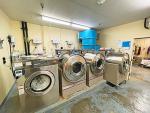
But with industrial laundry business deals dominating the news, one type of laundry has slipped under the radar: on-premises laundries or OPLs.
How have industrial laundry maneuverings affected OPLs? How many still exist in the market? Will OPLs continue to operate in the future?
Let’s dive into the OPL market to find some answers to these questions and others.
EFFECT OF LARGER OPERATIONS ON OPLS
How have national/regional/private equity industrial operations affected OPLs?
“This is a great question, because while directly or indirectly, over the last decade, private equity investment reduced choices in some markets they have entered,” says Bob Corfield, president and CEO of Laundry Design Group, a commercial laundry consultant with main offices in Las Vegas.
“By reducing the choices for COG (customer-owned goods) services, rental programs items, plant consolidation, and closures, many linen customers have seen service diminish and choices reduced while seeing costs double for certain size businesses.
“New plant development is not keeping pace with plant closures in many markets. We have seen a 4-to-1 ratio of closures to new plant builds since 2010 while the plants built are four times to six times capacity. They tend to not service small or rural customers very well or at all.”
Matt Alexander, president of Pertl and Alexander, a laundry consulting firm in Jamesville, N.Y., says that in healthcare, OPLs — with the exception of Veterans Affairs (VA) facilities — have largely disappeared.
“Linen rental providers achieve substantial efficiencies by consolidating textiles into standardized pools, making outsourcing far more economical than operating individual hospital laundries,” he says.
In hospitality, private equity acquisition and consolidation have produced mixed results, according to Alexander.
“In some markets, consolidation stabilized the supply chain by reducing excessive competition and predatory pricing, often resulting in higher prices,” he says. “In several cases, rising outsourcing costs have shifted the financial analysis, making it more viable for hotels to retain or reinvest in OPLs.”
Gerard O’Neill is president & CEO of American Laundry Systems, a division of E&O Mechanical Inc. in Derry, N.H. He says that, initially, the larger central laundries had huge success closing OPLs as it was hard to hide the true cost of OPL operations when all costs were considered.
“For the hotel management that was, shall we say, ‘enlightened,’ the savings from outsourcing was substantial and considered a no-brainer by management,” he says. “A lot of hotel/hospitality laundries were built and/or expanded at that time.
“Then there was a subtle shift, at first a smattering, and then a landslide in certain areas of the country. The central laundries got too big, too many customers, lack of maintenance, and reductions in budgets, leading to bad quality, and then fill rates fell off and/or missed deliveries started. The pressure for bigger and more profits, and the snowball effect, kicked in. One, then two, then 20, and then, inevitably, 200 OPLs open back up or even join forces to do their own central laundry.
“Right about this time, COVID kicked in. The hospitality business dries up overnight, as well as food and beverage. Only the strong survive, with many smaller or family-run businesses selling to the corporate giants. This just aggravates the situation, and post-COVID, the giants kick the smaller hotels out, and there are a lot of them, as the smaller family businesses lived on the smaller hotels, not the mega resorts that the corporate giants want for customers.”
James Scotton, regional sales manager for Dexter Laundry in Fairfield, Iowa, says the laundry equipment company is seeing increased consolidation as smaller commercial and industrial operations are acquired and combined into larger, multi-location operations that are built to scale.
“Similar to trends we’re seeing on the vended side of the business, private equity groups are acquiring smaller OPL industrial operations, rebranding them, and expanding across multiple regions of the country,” he adds.
Check back next Tuesday for a look at OPLs by markets and locations.

Have a question or comment? E-mail our editor Matt Poe at [email protected].