
CHANDLER, Ariz. — When it comes to delivering good hygiene in healthcare facilities, there is no one rule. There is a set of fundamentals. There are many different recipes.
That’s what Landry Guillochon, global manager of care institutions in the laundry business unit for Electrolux Professional, said when he presented European Perspective on Infection Control at the Association for Linen Management (ALM) conference here earlier this year.
“It’s up to you to choose the recipe that best fits your environment,” he says.
However, Guillochon believes the barrier concept solution and laundry cycle management offer sustainability to healthcare facilities.
Laundries in the United States and elsewhere have utilized pass-through washers for decades. When used as part of the cycle Guillochon describes, infection control can be enhanced.
If the facilities put the laundry function back into the center of the care delivery package, then they are fulfilling the mission of giving patients a new life, he says.
“The fact is that it is not just about the laundry room,” Guillochon says. “In many instances, we make a mistake about where does responsibility sit to deliver good hygiene? Not just about laundry. Everybody has a role to play. From dirty bed to clean bed, we’ll look at a holistic approach to good hygiene.”
BARRIER CONCEPT SOLUTION
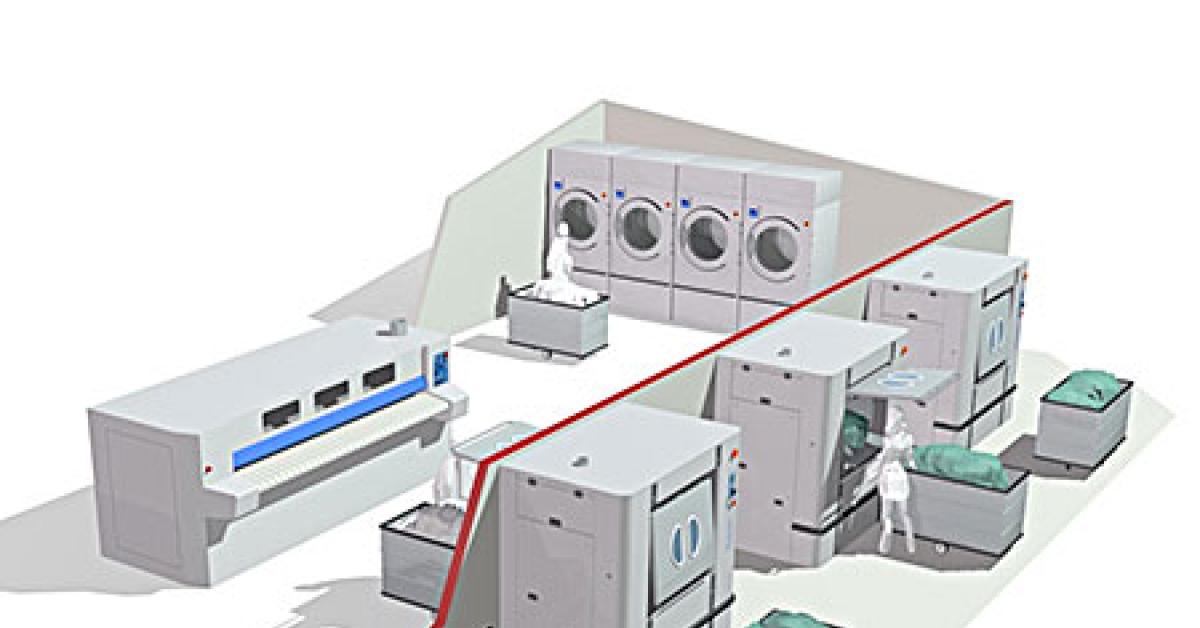
“The barrier concept is the best way to prevent cross-contamination with physical separation,” Guillochon says. “You’ve got the dirty side of the laundry separated by a physical wall from the clean side.”
Washers are equipped with a double door system, he says, and both doors can’t be opened at the same time. Operators and carts on the dirty side only touch dirty linen.
“There is no risk that on the other side an operator who has touched dirty linen comes in contact with clean linen, unless they are (David) Copperfield or Harry Potter,” says Guillochon. “That being said, the barrier concept is not the only solution. You can have good hygiene without barriers, but can you guarantee sustainability? Can you guarantee that at all times, people will do the right thing?”
He says that the international solution is all about making it easy. With the barrier concept, people cannot do wrong, because it is impossible.
If a healthcare organization and laundry want to deliver good hygiene, they need to have good organization, according to Guillochon. Good organization looks at a forward flow of linen. There is no coming back; it always moves forward, dirty to clean.
“The first thing you do is separate the entrance of your dirty from the exit of your clean,” he says. “And you try to position your equipment to where it’s going to end up in your laundry.”
Dirty linen comes into the dirty side and is stored there, waiting to be sorted, says Guillochon. Employees sort the linen and load the barrier washers, and the barrier washers are loaded according to where the items will be finished.
“Linen to be tumble-dried will be washed in line with the dryers,” he says. “Linen that goes through the flatwork ironer will be washed in line with the position of the ironers. And the linen that will be folded will be washed in the appropriate washers.”
But, the barrier concept is not just about the laundry, Guillochon says.
“The barrier concept is everywhere in a hospital and outside a hospital. You go to Japan and people who are sick, have colds, are educated to wear masks in order to protect their fellow citizens. That’s a barrier. The gloves people serving food wear is a barrier to prevent cross-contamination. In a hospital, it’s a very common thing,” he says.
Check back Thursday for the conclusion on laundry cycle management.
Have a question or comment? E-mail our editor Matt Poe at [email protected].